Removal, trimming, storm cleanup, and stump grinding across Statesboro and Bulloch County. Free written estimates before any work.
Call (555) 555-5555Or call — we answer. No obligation, honest advice.
For a long time Bulloch County counted itself far enough inland not to worry much about hurricanes. Matthew clipped it in 2016, Irma came through the following year, and pines came down from the campus neighborhoods out to the farm roads past Brooklet. People here recalibrated fairly quickly. The trees have not.
That is the honest situation, and it is worth saying plainly: this county's canopy grew up under an assumption that turned out to be wrong. Tall loblollies, grown close and grown fast, are standing in a place that now expects to be tested every few years. They did not get the memo, and they cannot adapt on the timescale that matters.
The tree map here is simple and demanding. Pines are everywhere - campus-area neighborhoods, newer subdivisions, and timber edges on nearly every farm. Live oaks and pecans anchor the older homesites, and they behave completely differently. Knowing which of those you have in the yard changes what needs doing and how urgent it is.
The way this works is straightforward. Someone looks at the tree, tells you honestly what it needs, writes the estimate down, and turns up on the day. Cleanup and haul-off sit inside a removal price from the start. When a tree is sound, you get told it is sound.
The plan comes first: where each piece can go, what sits underneath, and how the weight moves as the tree comes apart. With a tall pine close to a house there is not much margin, which is why sections come down on ropes rather than being felled and hoped for.
The site gets raked before we leave. Chips cleared, debris hauled, and the yard left looking like the tree is simply no longer there.
Removal, trimming, and stump grinding handle most of what a Bulloch County property needs, with storm response for the seasons that have earned the attention.
Dead, leaning, and storm-damaged trees taken down safely, including tall pines close to houses. Cleanup and haul-off included in the price.
Deadwood out, clearance over roofs, drives and service lines, and structural work on young trees. Cuts placed where the tree can seal them.
Stumps taken below grade so the ground can be replanted, sodded, or simply mowed across.
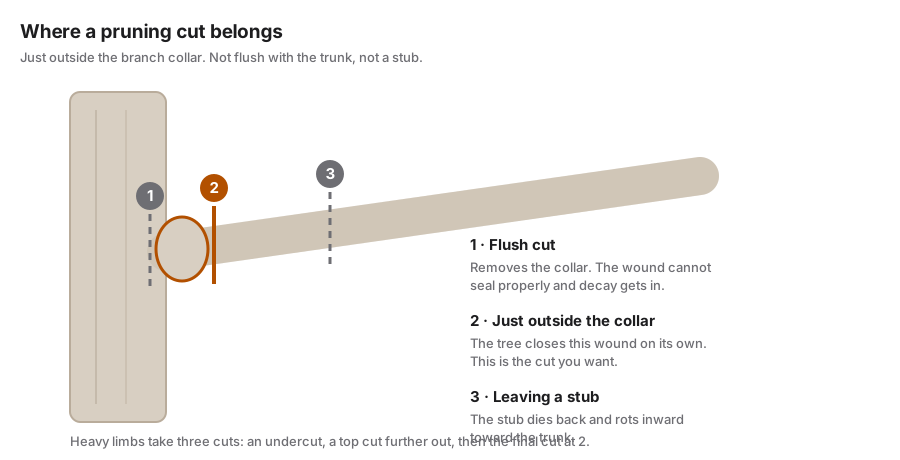
Most of what goes wrong in pruning comes down to a couple of inches. Where a limb joins the trunk there is a slightly swollen ring - the branch collar - and it holds the tissue a tree uses to grow over the wound left behind. A cut placed just past that ring lets the tree close itself without any help.
Cut inside the ring, flush against the trunk, and the healing tissue leaves with the limb. The wound never closes properly and decay moves inward. Leave a projecting stub and it dies back, then rots down into the trunk - the same ending by a slower route. Neither mistake is obvious the season it happens, which is why so much bad pruning goes unnoticed and unattributed.
There is one more rule worth knowing: a heavy limb comes off in three cuts, not one. Undercut first, then a relief cut further out to shed the weight, then the final cut at the collar. Take it in a single pass and the limb tears loose before the blade is through, peeling a strip of bark down the trunk as it drops.
This is the part of Bulloch County's tree situation that almost nobody explains, and it matters more than anything else on this page.
Plantation pines are grown deliberately close together. Crowded spacing forces trees upward rather than outward, which is exactly what a timber crop should do - tall, straight, minimal taper, few low limbs. What it also produces is a tree with a slender trunk relative to its height and a root system that never needed to brace against much wind, because its neighbors were sheltering it the whole time. Inside a full stand that works beautifully. The stand holds itself up collectively.
Then somebody clears part of it for a subdivision, or takes a section for timber, and the trees left along the new edge are suddenly exposed to wind they have never felt. Nothing about them changed - the situation changed. Those edge trees are the ones that come down in the first serious blow after the clearing, and it catches people out because the trees look perfectly healthy. They are healthy. They are simply built for a job they are no longer doing.
If your house backs onto a timber edge, or your subdivision was cut out of a pine stand in the last decade or two, that boundary row deserves a look on its own terms. Sometimes the answer is selective removal of the most exposed trees. Sometimes it is crown reduction to lower the sail area. Occasionally the answer is that the row has already been standing exposed long enough to have adapted, and nothing needs doing at all - trees do thicken and re-root over time when they have to.
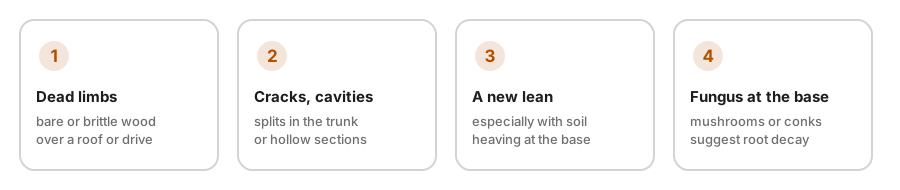
None of these condemns a tree by itself. All of them are cheaper to check in a quiet month than to deal with after something comes down.
The same sequence every time, whether it is one limb over a porch or a boundary row of pines.
Someone looks at the actual tree and writes the number down, with cleanup and haul-off inside it rather than added afterwards.
On a rental we need the owner or manager to approve the work, not just whoever answers the door. We will ask - it protects everybody.
Debris hauled, chips cleared, ruts avoided. A finished job leaves nothing behind except the space where the tree stood.
A university town has a lot of houses where the person living under the tree is not the person who owns it, and that creates a specific problem: the tree that worries somebody is frequently not the tree anybody has authority to deal with.
The practical version is simple. If you rent, you can absolutely call and have somebody look at a tree, and we are happy to put an assessment in writing that you can forward. What we cannot do is carry out work on a property without the owner's or the property manager's authorisation. That is not us being difficult - authorising tree work on a house you do not own creates a genuine problem for you, not for us.
If you own rental property here, the useful thing to know is that pines near a house are not a wait-and-see item, and the cost gap between a scheduled removal and an emergency one is substantial. A written assessment of the trees across a portfolio, done once in a quiet month, tends to be considerably cheaper than reacting to whichever one fails first. Several properties can usually be walked in a single visit.
One note for tenants worth stating plainly: if a tree is actively dangerous - visibly leaning onto the house, or dropping large limbs - put it to your landlord in writing rather than by phone, and keep a copy. That is ordinary sensible practice, and it tends to get things moving.
Statesboro is the base, and the service area covers Bulloch County - Brooklet, Register, Portal, Nevils, Stilson, Clito, Denmark, Leefield, and New Hope. That spans the campus-area neighborhoods, the newer subdivisions cut out of pine stands, and the farm and timber edges out past Brooklet.
Travel is part of the quote toward the far edges of the county, and we will say so on the phone rather than putting it on the invoice later. If you are just outside the list below, call and ask.
The older homesites around the county are anchored by live oaks and pecans, and it is worth knowing that they play by entirely different rules from the pines that surround everything else.
Live oaks are essentially built for wind - low, spreading, dense-wooded, with root systems that go wide. They are the trees most likely to still be standing after an event that flattens pines nearby, and they are also the slowest to replace in any meaningful sense. A live oak lost is not a gap that fills in ten years. That asymmetry is the reason to be sceptical of a quick recommendation to remove one, and to get a second opinion if you get one.
Pecans are the opposite kind of problem. The wood is brittle and the branch unions are weak, so limb drop is routine rather than exceptional, and old ones planted for nut production were never pruned for standing next to a roof. They usually need deadwood taken out and over-extended limbs shortened rather than removal - which is a trimming job at a trimming price.
The common thread is that species matters more than appearance. A pine that looks fine can be a genuine risk if it is standing exposed on a cleared edge; a live oak that looks alarming after a storm may be entirely sound and simply need tidying. Anybody quoting without making that distinction is not really assessing the tree.
Estimates are free and in writing. Removal prices on size, species, and above all access - a pine that can be dropped whole in an open field is a different job from the same pine standing between a house and a fence. Trimming prices on scope, stump grinding on diameter and count. None of it can be quoted honestly from a phone description, which is why someone comes out and looks.
Call (555) 555-5555 for removal, trimming, storm cleanup, or stump grinding anywhere in Statesboro and Bulloch County. And one caution this county has earned: after any significant storm, crews arrive from out of the area wanting cash and money up front. Apply the same rules to anyone, including us - scope in writing before work starts, no large deposit, and a certificate of insurance sent to you directly by the insurer rather than shown as a photocopy.
Tell us what you need and we'll get back to you with a real answer. If it's an active backup or standing water over the field, calling gets you a faster response.
Call: (555) 555-5555
Area: Statesboro, GA and Bulloch County